Overview
- The import keyword in Python loads a Python package, a Python sub-package or a Python module and introduces their namespace into the current scope.
- A module can be imported using the Python package importlib as well through its method import_module().
- When import is used against a module name, the module is searched, found and loaded by a set of finders and loaders.
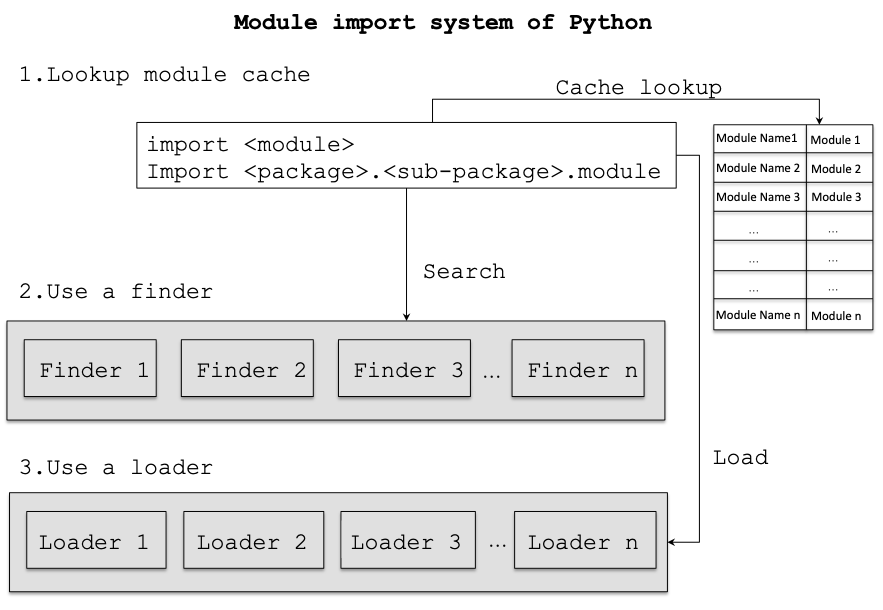
Searching a Python module
- The module name encountered in the Python import statement is first made a lookup in the dictionary sys.modules.
- sys.modules acts a cache for the modules.
- If the lookup is successful the module object is loaded from the dictionary. If the lookup on sys.modules fails, the module is searched further.
- When the Python's import system gets a None value while doing a look up for a module name, it raises a ModuleNotFoundError.
Finding a Python Module
- A finder uses a strategy and finds the given module in the system where Python is installed.
- Upon successfully resolved a given module to a path - a finder returns a module specification, which contains the information about the module to be loaded.
Loading a Python Module
- Using the module specification a loader loads the python module and executes the module. Remember, a Python module contains both executable statements and definitions like function definitions.
- A class can combine the responsibilities of a finder and a loader, which is called an importer.