Overview
- Net Present Value is a tool for selecting among multiple investment avenues.
- The rule of Net Present Value is to select an investment with a maximum positive NPV and reject the investments that warrant negative NPV or lesser NPVs.
- The formula for NPV is
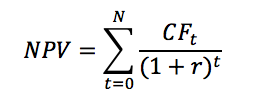
CFt - Net cash flow at time t
N - Total number of Periods
r - Discount rate or rate of return
- Given a series of cash flows the numpy.npv() method returns the Net Present Value of the cash flows.
Example 1: Calculating the NPV for an investment
import numpy as np

cashflows       = [-500, 200, 147, 128, 130, 235]; # t0, t1, t2, t3, t4, t5

discountRate    = 0.9; # Nine percent per annum

npv             = np.npv(discountRate, cashflows);

print("Net present value of the investment:%3.2f"%npv);
Output
Net present value of the investment:-315.89