Method Name
poll()
Overview
Using select() the number of descriptors that can be monitored is dependent on the FD_SETSIZE of the platform which is normally set to 1024. If a network program has to monitor a number of descriptors beyond FD_SETSIZE, select() can not be used.
Using the method poll() there is no limit on the number of descriptors.
poll() is event based.
Using poll() a set of I/O events can be registered for a descriptor through the register() function.
A call to method poll(timeout) will return a list of tuples where each tuple is comprised of a file descriptor and the event. If no event occurred within the time as specified by timeout, an empty list will be returned.
Iterating through the list of tuples, I/O events can be processed for specific descriptors.
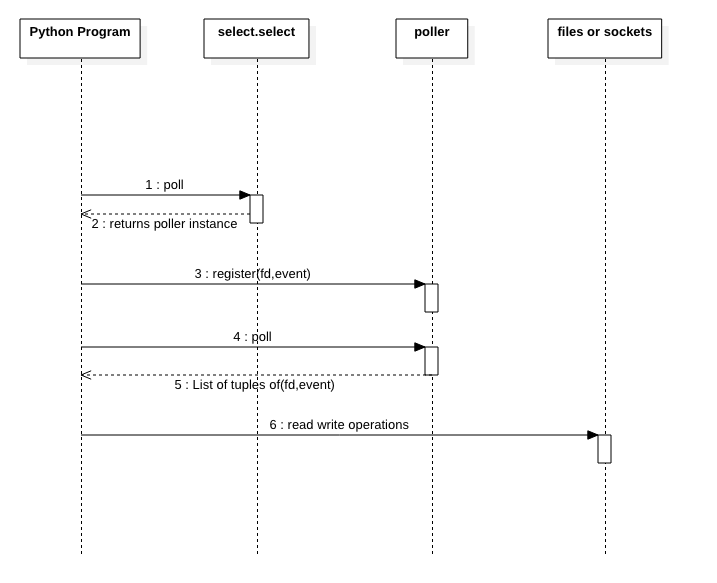
Parameters
Not applicable
Return Value
Returns a Polling object
Example
import select

import socket

import os

serverSocket    = socket.socket(socket.AF_INET, socket.SOCK_STREAM)

serverSocket.setsockopt(socket.SOL_SOCKET, socket.SO_REUSEADDR, 1)

ipAddress   = '127.0.0.1'

portNumber  = 20000

serverSocket.bind((ipAddress, portNumber))

serverSocket.listen()

pollerObject = select.poll()

pollerObject.register(serverSocket, select.POLLIN)

while(True):

    fdVsEvent = pollerObject.poll(10000)

    for descriptor, Event in fdVsEvent:

        print("Got an incoming connection request")

        print("Start processing")

        # Do accept() on server socket or read from a client socket