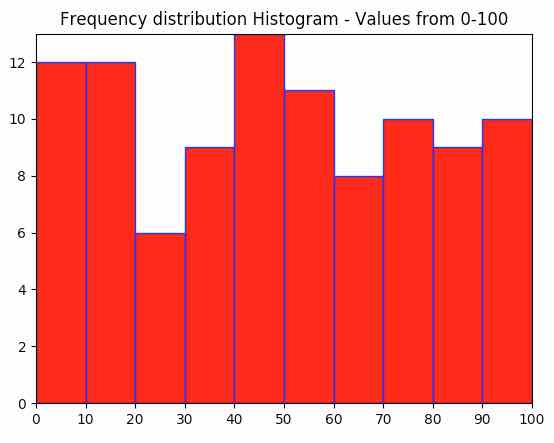
Histogram Overview
- A Histogram is a vertical bar chart.
- A Histogram has continuous intervals in the X-axis and the frequencies in the Y-axis.
- While X-axis of the histogram describes the interval of the data that is start value and end value of the data, the Y axis of a histogram describes the frequencies of such data.
- In other words the height of the histogram describes the frequency of the data and the width of a rectangle in the histogram describes the range of values of data.
- Histogram gives a good overview of how the density of the data is distributed.
- The python library matplotlib has the hist() function and a hist2d() function that plot a histogram.
Example
import matplotlib.pyplot as plot

import numpy as np

# Random number generation from 0 to 100

x1      = np.random.random_integers(0,100,100)

# Plot frequency distribution using histogram

plot.hist(x1, facecolor="r", edgecolor='b')

plot.title("Frequency distribution Histogram - Values from 0-100")

plot.margins(0)

plot.xticks(range(0,110,10))

# Display the histogram

plot.show()
Output